
Jackson’s Complicated History of Race, Civil Rights and the Ku Klux Klan

Updated: 21 minutes ago
In 1854, Jackson was a gathering place for antislavery activists who helped organize a new political movement opposed to the expansion of slavery. Seventy years later, on July 4, 1924, thousands of Ku Klux Klan members marched through the same community as part of one of the top three largest Klan gatherings held in the nation. The two events stand among the more striking contrasts in Jackson County history. The community known for abolitionists, assistance to freedom seekers and later support for African American soldiers during the Civil War would also experience segregated schooling, a massive Klan presence, blackface minstrel shows, racially restrictive housing covenants and racial tensions that continued well into the 20th century.
Jackson’s early reputation was closely connected to the antislavery movement. Abolitionists operated throughout the area, helping freedom seekers, holding public meetings and speaking openly against slavery decades before the Civil War. Seymour Treadwell addressed an audience at the Jackson courthouse in 1839, and self-emancipated abolitionist Henry Bibb spoke there on human rights in 1850. Jackson’s newspapers also became part of the movement. The American Freeman, established in the late 1830s, was Michigan’s first strictly abolitionist newspaper, while other local papers regularly spoke against slavery. The DeLand family became closely connected to Jackson’s Underground Railroad activity. William and Mary DeLand opened their home to freedom seekers, sometimes sheltering several people at once, while their son Charles later recalled transporting them by wagon through Leoni and Waterloo to the next stop along the route. Charles continued that work as an adult through the American Citizen, where he regularly wrote against slavery. Some freedom seekers also chose to remain in Jackson. Emma and Richard Nichols, both born into slavery, eventually established their lives in the city after reaching freedom, becoming part of the Black community that was taking root in Jackson before the Civil War.
On July 6, 1854, antislavery leaders and ordinary citizens gathered in Jackson for the convention remembered as Under the Oaks. The meeting came only weeks after passage of the Kansas-Nebraska Act, which repealed the Missouri Compromise restriction on slavery and opened Kansas and Nebraska to the possibility of slavery through popular sovereignty. The law created widespread anger across the North and helped break apart the old political parties as former Whigs, Free Soilers, antislavery Democrats and others came together in opposition to the expansion of slavery. In Jackson, that movement helped found and organize the new Republican Party in Michigan. Those gathered adopted the Republican name, approved an antislavery platform and nominated a statewide ticket. Michigan’s July 6 convention was the first state convention to formally organize under the Republican name and became one of the foundational events in the creation of the national party, which Abraham Lincoln would later lead to victory in the 1860 presidential election.

Yet Jackson’s strong antislavery reputation did not mean racial discrimination disappeared at home. In March 1866, the Jackson school board considered a petition calling for the immediate establishment of a separate school for Black children and requiring Black students then attending the city’s other schools to attend it instead. The petition was signed by several named residents and 67 others. The board agreed, directing that a room be secured, furnished and staffed with a teacher for Black students living in the district. It further ordered that once the separate school opened, Black students wishing to attend school would be required to attend that school rather than the city’s regular public schools.
The policy was challenged later that year by George Washington, a 19-year-old Black resident who had lived in Jackson’s school district since 1856. According to an affidavit published in the Jackson Weekly Citizen in January 1867, Washington applied in November 1866 to attend one of the district’s regular schools. Principal Judson C. Lowell refused, informing him in writing that, by direction of the school board, he was not authorized to admit Black students to the regular public schools. Washington stated that he knew of no reason for his exclusion other than his race. He also argued that the separate school was less convenient for students living in distant parts of the district and was not as good as Jackson’s regular graded schools.
Former Michigan Gov. Austin Blair took Washington’s case to the Michigan Supreme Court, seeking a writ of mandamus that would require school officials to admit him to any public school for which he was academically qualified and to stop making distinctions between students based on race. The Weekly Citizen described the case as attracting “universal interest throughout the State” because it was expected to establish a precedent for similar disputes. The school board prepared to fight the case through its own attorneys. Later in 1867, the Michigan Legislature enacted a law declaring that all residents of a school district had an equal right to attend its schools.

The contradiction became especially visible during the 1920s, when the second Ku Klux Klan spread rapidly across Michigan. The Klan was not limited to the South, nor was it confined to a handful of isolated Michigan communities. Historian Craig Fox found Klan activity across much of the state, with local units operating in cities, small towns and rural areas. Jackson appears to have been one of the organization’s stronger Michigan centers. In a February 1924 letter, U.S. Rep. Earl C. Michener wrote that the Klan was “very active in Michigan” and claimed that Jackson alone had more than 5,000 members. The number was Michener’s contemporary estimate rather than a verified membership count, but it shows how substantial the organization’s presence in Jackson was believed to be. Jackson also had two known Klan chapters, which maintained offices in a building at Mechanic and Pearl streets near downtown.
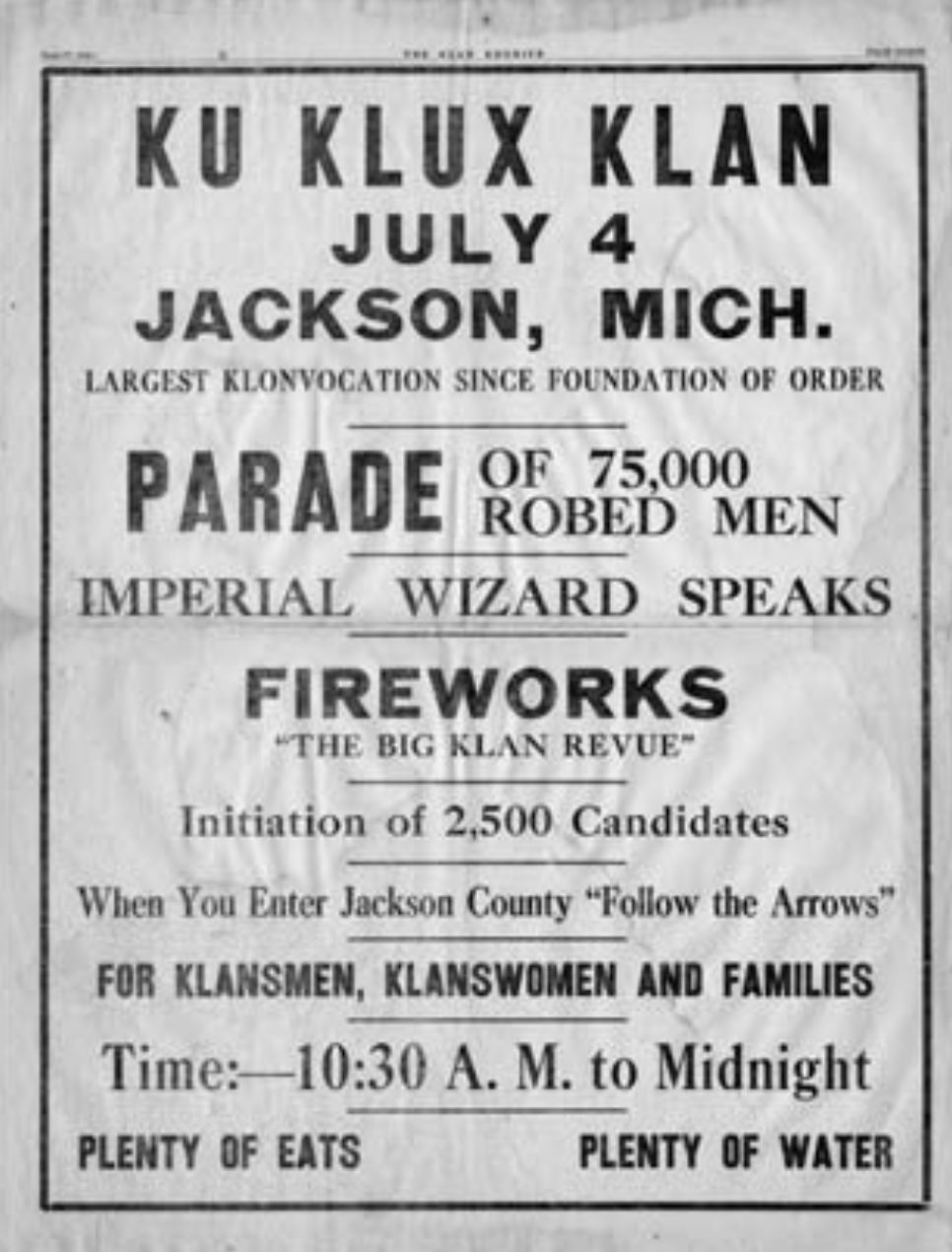
That presence became impossible to miss over the Independence Day weekend of 1924. The July 5 edition of The Jackson News placed the gathering across the front page beneath the headline, “Klan Parade Was a Monster Affair,” calling it the largest parade of its kind ever seen in the city and estimating approximately 7,000 marchers. The Jackson Citizen Patriot also devoted prominent front-page coverage to the event, reporting that thousands of Klan members had filled the city to hear Imperial Wizard Hiram Wesley Evans.
Total attendance was much greater than the number of people who marched. Klan sources later claimed that 100,000 people heard Evans speak and that as many as 200,000 were present by the evening fireworks. Fox cautioned that those figures were probably exaggerated, but noted that surviving photographs leave little doubt that the event was extremely large. He also found a Klan claim that 47,281 automobiles had been counted at the 112-acre grounds. Rather than accepting those enormous figures as exact, the surviving evidence makes the safer point clear: tens of thousands of people came to Jackson for the gathering.


This was also much more than a meeting where people listened to speeches. It was a heavily organized, multi-day gathering that brought visitors into Jackson from across Michigan. The Michigan Electric Railway operated at least 17 special trains and 12 buses into the city, while the Michigan Central Railroad added extra coaches to its regular trains. Roads around Jackson County were marked with signs directing motorists to the grounds, hotels were booked ahead of the gathering and some local residents rented spare rooms to visitors.
At the grounds, visiting Klan units established headquarters in what was described as a temporary “city of tents.” Food, drinks, souvenirs and other concessions were available, while a nursery cared for children and a temporary hospital treated people suffering from exhaustion during the July heat. Contemporary descriptions said the grounds resembled a large fair, with men, women and children gathering among the tents and thousands of automobiles surrounding the site.
The parade moved directly through Jackson rather than remaining on the gathering grounds. More than 7,000 Klansmen representing 42 Michigan counties were reported to have participated. The procession began near Seymour Street and traveled through downtown along West Michigan Avenue to the Civil War monument on Wildwood Avenue. From there it continued along West Michigan Avenue, West Avenue and Ganson Street before returning to Seymour Street and the gathering grounds. Contemporary newspaper coverage reported that four mounted city police officers led the procession, followed by mounted Klansmen, bands, delegations and floats. Spectators filled the route as the parade continued for more than an hour. The Jackson News reported frequent cheering from the crowd and described American flags being carried throughout the procession.
Not everyone in Jackson welcomed the Klan. Louise Austin Lines, who was 11 years old in 1924, later recalled watching the parade near Wildwood and West Michigan avenues and remembered a “huge, huge crowd” filling the area. She said her parents later explained to her what the organization represented and told her it was “founded on hate.” Looking back nearly nine decades later, Lines remembered being disturbed that so many people could support it. Her account provides an important reminder that the thousands who watched the spectacle should not automatically be counted as supporters of the Klan.
Fox also found accounts saying residents along the parade route provided water to marchers during the summer heat, while Klan publications claimed that cheering and handclapping continued along the route. Fox cautioned against taking the organization’s own description of its reception at face value, but concluded that the size of the event required significant local cooperation and assistance.

The parade showed how the Klan mixed its beliefs with patriotism, religion and popular entertainment. The Citizen Patriot, as quoted by Fox, described three “little red school houses” among the floats, carrying variations of the message that public schools should be attended by all children. Other displays carried messages including “Protection of Womanhood,” “The Fiery Cross,” “Spirit of 1924” and “The Public School Is My Child. Protect It!” Another float depicted immigrants in a derogatory manner beneath a message opposing “undesirable immigration,” and the newspaper reported applause from people along the parade route.
The school issue had particular meaning in the Klan politics of the time. Evans and Mary J. Bishop, a leader of Michigan’s Women of the Ku Klux Klan, used the gathering to support a proposed parochial-school measure that Fox describes as anti-Catholic. The second Klan targeted Catholics and immigrants in addition to Black Americans and promoted a version of “Americanism” centered heavily around white Protestant identity. Patriotic symbols appeared throughout the Jackson gathering alongside Klan symbols. Photographs reproduced in Fox’s research show civilian spectators standing alongside unmasked Klan members and a Kalamazoo women’s Klan float decorated with Uncle Sam, Lady Liberty and a fiery cross.
Women and young people were also involved. Women’s Klan organizations participated in the gathering, while junior groups appeared in the parade and at the grounds. Fox found that organizers specifically invited Klanswomen, junior organizations and other interested white Protestants to Jackson. The Women of the Ku Klux Klan even offered $5 in gold to the largest delegation of Tri-K girls, part of a Klan youth organization. In Michigan, Klan organizations were actively trying to bring children and teenagers into their activities as future members.

Entertainment was another major part of the event. Klan bands played organization songs, patriotic music and religious hymns, including “Onward Christian Soldiers.” Airplanes performed over the grounds, and one nighttime stunt involved an electrically illuminated red cross beneath an aircraft. The program also included speeches, initiation ceremonies, cross displays and fireworks. Fox’s research shows how gatherings such as Jackson’s were designed to look not only like political demonstrations but also like large public celebrations that families could attend. For a period during the early 1920s, that helped the Klan become far more visible in ordinary Michigan community life than its later reputation as a secret organization might suggest.
The 1924 gathering was not the end of racial stereotypes or discrimination in Jackson. In 1934 and 1935, Kiwanis minstrel shows were held at the Jackson High School auditorium to raise money for charity during the Great Depression. A surviving photograph from the 1935 production shows numerous white performers in blackface. Such performances had been common in American entertainment for generations and relied heavily on exaggerated portrayals of African Americans.

Discrimination was also written directly into the development of Jackson neighborhoods. A 1939 property deed covering lots around Webster and Elmwood streets in Jackson’s 6th Ward stated that the properties were not to be sold to or occupied by anyone other than a person of the “Caucasian race.” Restrictive covenants, discriminatory lending practices and other housing barriers limited where Black families could purchase homes and contributed to divisions that carried into schools and other parts of community life.
Those tensions remained visible during the civil rights era. In September 1963, Parkside High School became the center of several days of racial tension involving students, parents and police. Black students made up about one in seven students at Parkside, and many walked through predominantly white neighborhoods each day to reach the school at a time when housing in Jackson remained heavily divided by race. The confrontation also came amid the growing national civil rights movement and only days after the bombing of the 16th Street Baptist Church in Birmingham, Alabama, which killed four Black girls. A later Citizen Patriot account recalled that events in Alabama were very much on the minds of Black students and their families in Jackson.
On Sept. 18, fighting and rumors of additional fights at Parkside spilled into the surrounding streets after school, bringing a large police response and crowds of students and residents. The Citizen Patriot described the disturbance under the headline “200 Battle Police in School ‘Rumble.’” Police Chief Gray instructed 14 officers assigned to the area to use only the force necessary to keep the situation under control. Students later accused officers of rough treatment, while police and others offered differing accounts of what had happened. That evening, an NAACP-called meeting at Community AME Church drew an estimated 200 to 300 Black residents to hear students describe their experiences. Local leaders, including NAACP President Harold White Sr. and attorney William F. Goler, also went into the streets and used police loudspeakers to urge crowds to leave peacefully. Gov. George Romney was alerted to the unrest, with state police prepared to respond if Jackson authorities requested assistance.

At the same time, Jackson produced generations of people who worked against those barriers. Lucy Thurman carried her work on behalf of Black women and girls from Jackson to the national stage, while later leaders organized around problems much closer to home. During the 1963 Parkside High School unrest, NAACP President Harold White Sr., attorney William F. Goler and other Black leaders worked to calm crowds while also demanding answers about the treatment of Black students. Community AME Church became a gathering place where hundreds of residents, students, ministers and civil rights leaders met to discuss what had happened and the larger problems behind it. A 2001 Citizen Patriot retrospective noted that the Parkside incident led to a series of meetings involving parents, school officials, civil rights leaders and police, with concerns extending beyond the disturbance itself to housing, policing and the treatment of Black students in Jackson. Later figures including Benny Poole and Charles Montgomery continued that tradition through music, youth programs and community institutions.
Jackson County’s history of race and civil rights is therefore more complicated than its abolitionist reputation alone might suggest. The same community where abolitionists assisted freedom seekers and antislavery political leaders gathered in 1854 was maintaining a separate school for Black children little more than a decade later. In 1924, thousands of Ku Klux Klan members marched openly through Jackson as tens of thousands of visitors and spectators crowded the city. Blackface minstrel shows were still being staged in the 1930s, while restrictive covenants limited where Black families could live. By 1963, students at Parkside High School were confronting racial tensions that brought police, parents and civil rights leaders into the streets and community meetings. The issues changed over time, but the divide between Jackson’s reputation for freedom and the experiences of many of its Black residents remained visible.
The antislavery movement of the 1800s remains an important part of Jackson’s history, but it was never the entire story. Jackson had residents who spoke against slavery, helped people reach freedom and later challenged segregation and discrimination, while at the same time the community struggled with unequal schools, housing restrictions, racial stereotypes and organized white supremacy. The historical record does not erase either side of that history. Instead, it shows that progress and discrimination often existed at the same time, and that questions over race and equality continued from George Washington’s challenge to segregated schools in the 1860s to the students, parents and civil rights leaders confronting many of those same issues a century later.


Comments